


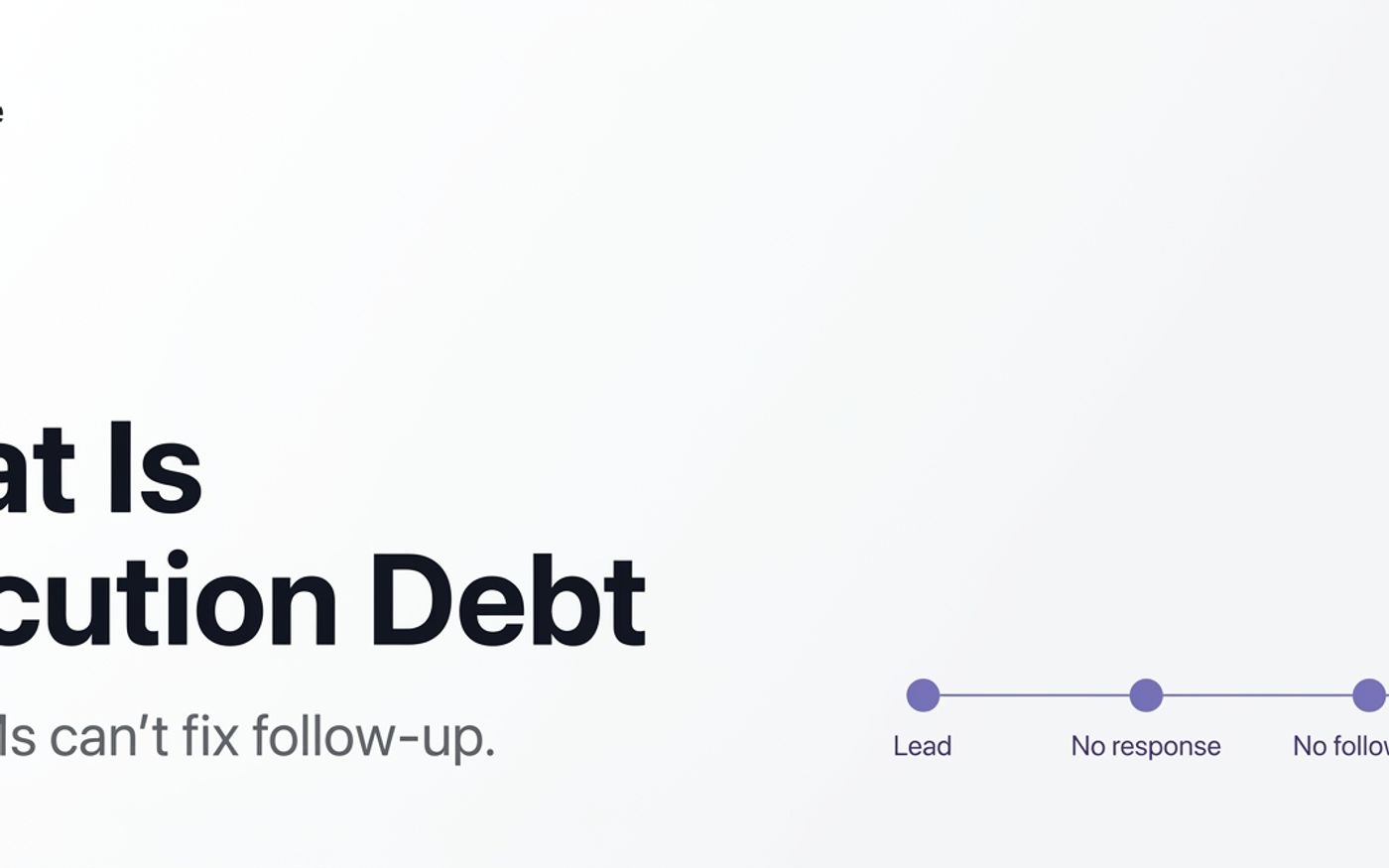
Most teams do not lose revenue because they lack leads. They lose revenue because opportunities stop moving.
A Meta lead comes in at 9:04 PM. Nobody calls. By morning, the buyer booked with someone faster. The CRM still has the contact. The deal is already gone.
That gap — between interest and action — is execution debt. It compounds quietly. And no amount of pipeline fields will pay it down.
What is execution debt?
Execution debt is the accumulated cost of work that should have happened — and did not.
It shows up as missed first responses, follow-ups that never fire, leads with no owner, and deals that sit with no next step. The opportunity was real. The system just failed to keep it moving.
Think of it like technical debt, but for revenue. Every skipped call, every unanswered form, every “I’ll get to it after this showing” adds interest. By the time you notice, you are not looking at a process issue. You are looking at paid demand that never got worked.
Why CRMs alone cannot fix it
A CRM is excellent at recording. Contacts, stages, notes, reports — storage is the job.
Execution is different. Execution asks: who owns this lead right now, what happens in the next five minutes, and what happens if nobody acts?
When teams buy another CRM hoping it will “fix follow-up,” they usually get better record-keeping on the same leaks:
- Leads land in a shared inbox and wait for someone to notice
- Hot inbound sits overnight because no SLA or alert exists
- Reps dig through tabs before they can dial
- Managers find out Monday that Tuesday’s paid leads went untouched
The CRM did not fail at being a database. It failed at being an execution layer — because that was never what it was built to be.
Where execution debt shows up
1. Speed-to-lead collapses after hours
Inbound intent does not wait for business hours. Meta ads, open-house forms, and portal inquiries peak when your team is in showings or offline. Without alert → assign → call, response time stretches from minutes to the next morning — and first-responder advantage is gone.
2. Follow-up depends on memory
Good intentions do not scale. If the next touch lives in someone’s head, it dies when the day gets busy. Cadences and tasks exist so silence is not the default.
If this sounds familiar, start with seven reasons teams miss follow-ups — then build the system that removes those failure points.
3. Ownership is fuzzy
“Someone will handle it” is how leads disappear. Routing without a named owner and a first-response SLA is just a faster way to create orphans.
4. Managers see revenue late, not the leak early
Closed deals are lagging indicators. Contacted rate by source, time-to-first-touch, and SLA breaches tell you where execution broke — before the month ends and the ad budget looks “bad.”
The real cost
Execution debt is expensive because it hides inside metrics you already trust.
| What you see | What is actually happening |
|---|---|
| High CPL / low conversion | Leads arrived; first contact was too slow |
| “Lead quality is bad” | Many leads never got a real attempt |
| Full pipeline, soft forecast | Deals stall with no next step or owner |
| Busy team, flat revenue | Activity without accountability on inbound |
Before you spend more on top-of-funnel, ask what percentage of last month’s inbound got a first touch within your SLA — and what happened to the rest.
How to pay it down
You do not eliminate execution debt with a pep talk. You change the system.
Make every hand-raise land with an owner
Capture Meta, forms, and referrals into one queue. Assign automatically. Deduplicate. No spreadsheet triage after the fact.
Turn inbound into alert → call
Push when a hot lead arrives. Start an SLA clock. Open the record call-ready. Speed-to-lead becomes a workflow, not a hope.
For the operational version of this, see speed to lead as a system and estimate delay cost with the speed-to-lead calculator.
Queue the next attempt when the first misses
Missed calls are normal. Missed systems are optional. Cadences and draft follow-ups should queue while people are busy — with humans approving what customers see.
Measure contacted rate, not just closed volume
Track time-to-first-touch and contacted rate by source. That is how brokers and team leads see whether paid demand is actually getting worked.
Storage vs execution
| CRM storage mindset | Execution mindset |
|---|---|
| Did we save the lead? | Did someone work the lead? |
| What stage is it in? | What happens next, and by when? |
| Who has access? | Who owns the next five minutes? |
| Activity log exists | SLA breach is visible and escalated |
You still need records. You also need motion. FlowForce exists for the second job: every lead gets worked — contacted, followed up, and accounted for until there is an outcome.
A simple test for your team
Pick ten inbound leads from last week. For each one, answer:
- When did it arrive?
- Who owned it within five minutes?
- What was the first contact attempt — and when?
- What was the next scheduled step if they did not answer?
- Can a manager see that story without asking around?
Gaps in those answers are execution debt. Closing them beats buying another place to store names.
Every lead gets worked
Execution debt is not a motivation problem. It is a systems problem.
CRMs remember. Execution software makes sure opportunities keep moving — from capture to call to follow-up to close — even when the day gets messy.
If your team is paying for leads that die in silence, start free and prove the loop: capture, execute, follow up, close.