One of the most common CRM mistakes is not choosing the wrong software.
It is using the right software the wrong way.
Many businesses use lead status and deal stage interchangeably. At first, this seems harmless, but over time it creates inconsistent pipelines, confusing reports, and unreliable sales forecasts.
The two concepts answer completely different questions:
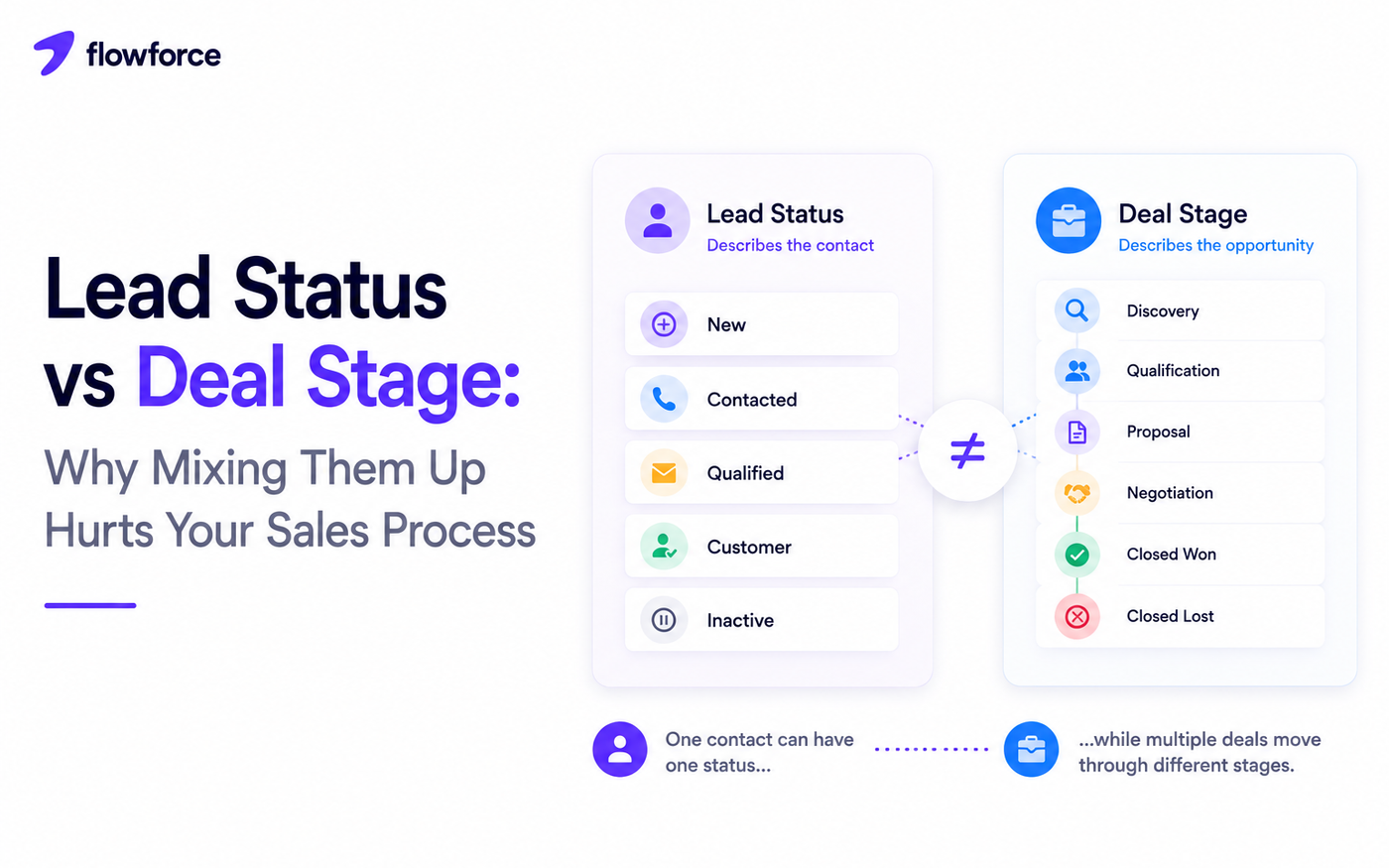
- Lead status describes the relationship with a contact.
- Deal stage describes the progress of an opportunity.
Understanding that distinction makes your CRM easier to use and your sales process far more consistent.
This article completes the Modern CRM Workflow cluster — read it alongside pipeline stages, pipeline hygiene, and follow-up automation.
What Is Lead Status?
Lead status describes the current state of a person or organization in relation to your business.
It focuses on the contact, not the sale.
Typical lead statuses include:
- New
- Contacted
- Attempted contact
- Qualified
- Unqualified
- Nurturing
- Customer
- Inactive
A contact's status may remain unchanged even while multiple opportunities are created over time.
What Is a Deal Stage?
A deal stage represents where a specific sales opportunity sits within your pipeline.
It focuses on the opportunity, not the contact.
Common stages include:
- Discovery
- Qualification
- Proposal
- Negotiation
- Closed won
- Closed lost
Every opportunity should move through these stages independently.
Define exit criteria for each stage in CRM pipeline stages explained — stages are for opportunities, not contacts.
Lead Status vs Deal Stage
| Lead status | Deal stage | |
|---|---|---|
| Describes | The contact | The opportunity |
| Cardinality | Usually one active status | Multiple opportunities possible |
| Time horizon | Long-term relationship | Short-term sales process |
| Primary use | Segmentation and nurture | Forecasting and pipeline |
| Focus | Contact-focused | Opportunity-focused |
A Real-World Example
Imagine Sarah downloads your pricing guide.
Her lead status becomes: Qualified lead.
A week later, your sales team opens a new opportunity. That opportunity progresses through discovery, proposal, negotiation, and closed won.
Months later, Sarah returns with a second project. Her lead status is still Customer, but a brand-new deal enters the pipeline at discovery.
The contact remains the same. The opportunity is new.
That pattern is normal in B2B and services — and it only works when status and stage live on separate fields.
Why Mixing Them Up Causes Problems
When businesses use one field for both concepts, they often experience:
- Confusing reports that blend relationship and pipeline metrics
- Duplicate records when reps create new contacts for repeat buyers
- Inaccurate forecasts because status changes masquerade as pipeline progress
- Stalled opportunities with no clear next step
- Poor pipeline visibility for managers
- Difficult automation because triggers fire on the wrong object
Separating contact information from opportunity progress creates a much cleaner CRM.
Messy data also kills forecast accuracy — hygiene reviews assume status and stage are distinct.
When Should Each One Change?
Update lead status when
- A new inquiry arrives
- Qualification is complete
- The contact becomes a customer
- The relationship changes (churn, re-engagement, partner)
- The contact becomes inactive
Update deal stage when
- Discovery is completed
- A proposal is sent
- Negotiation begins
- The opportunity is won
- The opportunity is lost
One tracks the relationship. The other tracks the sale.
Best Practices
To keep your CRM organized:
- Keep lead status simple — fewer values mean higher adoption
- Define clear exit criteria for every deal stage
- Do not overload either field with hybrid labels like Proposal Customer
- Automate updates where the trigger is unambiguous
- Train your team to understand the difference in onboarding
- Review both fields in weekly pipeline hygiene reviews
Small improvements in CRM structure lead to much better reporting.
New hires should learn this on day one — see lead routing rules for how assignment fits contact records, not deal stages.
Automation Opportunities
Separating lead status and deal stage allows your CRM to automate smarter workflows. Examples include:
- Create a deal when a lead becomes qualified
- Notify sales when a deal enters negotiation
- Trigger onboarding when a deal is won
- Start a nurture campaign after a lost deal
- Assign follow-up tasks based on stage changes — not status alone
Automation works best when each field has a single, well-defined purpose.
See seven practical workflows in follow-up automation and log every action on your
How Flowforce Keeps Contacts and Deals Organized
Flowforce separates contacts from opportunities so your team always knows what they are looking at.
With Flowforce, you can:
- Track contact relationships with clear lead status
- Manage multiple opportunities for the same customer
- Build customizable sales pipelines per motion
- Automate stage-based workflows without corrupting contact status
- View complete customer histories on one timeline
- Improve forecasting accuracy with opportunity-only pipeline data
Instead of forcing one field to do two jobs, Flowforce keeps your CRM structured and easy to understand as your business grows.
Not sure you need separate objects at all? Read customer management software vs CRM and explore Flowforce documentation for contacts and deals setup.
Frequently Asked Questions
What is the difference between lead status and deal stage?
Lead status describes the relationship with a contact, while deal stage tracks the progress of a specific sales opportunity.
Can one contact have multiple deals?
Yes. A customer may have several opportunities over time, each with its own deal stage, while maintaining a single contact record.
Why should not I use lead status as my pipeline?
Lead status is not designed to represent the sales process. Mixing the two concepts makes forecasting and reporting less accurate.
Should lead status changes be automated?
In many cases, yes. For example, a qualified lead can automatically create a new opportunity while retaining its contact history.
Build a CRM That Matches How Sales Actually Works
When contacts and opportunities are managed separately, your team gains clearer pipelines, more reliable reports, and better forecasting.
Discover how Flowforce helps growing businesses organize customer relationships, automate workflows, and keep every opportunity moving through a structured sales process.