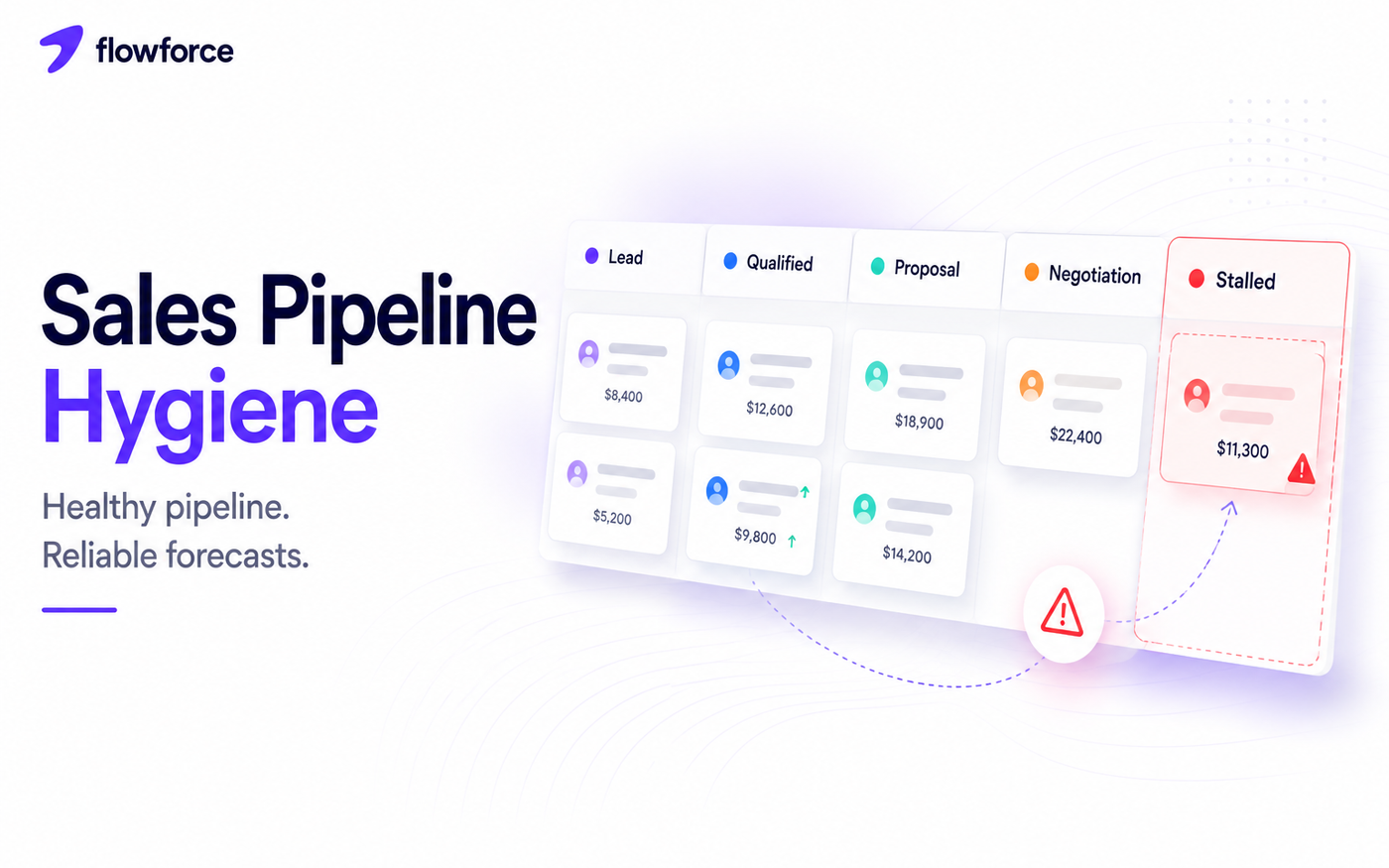
A full pipeline does not always mean a healthy pipeline.
Many sales teams mistake activity for progress. Deals remain open for months, outdated opportunities inflate forecasts, and managers make decisions based on inaccurate data.
This is where pipeline hygiene becomes essential.
Sales pipeline hygiene is the ongoing process of keeping your CRM accurate, up to date, and representative of what is actually happening in your sales process.
In this guide, we explore the ten most common pipeline hygiene mistakes and how to avoid them.
Hygiene sits on top of your workflow foundation — pipeline stages, follow-up automation, and a complete activity timeline.
What Is Sales Pipeline Hygiene?
Pipeline hygiene is the practice of maintaining clean, accurate, and actionable sales data.
A healthy pipeline helps teams:
- Forecast revenue more accurately
- Identify stalled opportunities before they go cold
- Prioritize the right deals instead of the loudest ones
- Improve sales coaching with real stage and activity data
- Build confidence in reporting across leadership
Without good hygiene, even the best CRM becomes unreliable — and managers stop trusting the numbers.
Why Forecast Accuracy Depends on Pipeline Quality
Forecasts are only as reliable as the data behind them.
If opportunities remain in the wrong stage, lack recent activity, or have unrealistic close dates, revenue projections quickly become misleading.
Healthy pipelines produce better forecasts because every opportunity reflects its true status — not optimism left unchecked.
10 Pipeline Hygiene Mistakes
1. Keeping dead deals open
Not every opportunity will close. Leaving inactive deals in the pipeline creates false optimism and inflates forecasts. Review opportunities regularly and close those that are no longer active.
2. No activity for weeks
If a deal has not had meaningful activity in several weeks, it deserves attention. Monitor calls, emails, meetings, notes, and tasks on the timeline.
A quiet deal is often a stalled deal.
If activity is missing, your CRM activity timeline cannot do its job.
3. Unrealistic close dates
One of the most common forecasting mistakes is repeatedly pushing expected close dates into the future. Review close dates based on actual customer progress — not hope.
4. Skipping pipeline stages
Every stage should represent a measurable milestone. When reps skip stages, managers lose visibility into where deals are actually progressing. Consistency matters more than speed.
Document exit criteria in your CRM pipeline stages guide and enforce them in pipeline reviews.
5. Missing next steps
Every opportunity should answer one simple question: what happens next? If there is no scheduled activity or assigned task, the deal is at risk of stalling.
Automate next steps with follow-up automation workflows so tasks are created when outcomes change.
6. Incomplete customer information
Missing decision makers, budgets, contact details, or notes slow down future conversations. Complete records improve collaboration across the team — especially after routing or handoffs.
Clean assignment starts with lead routing rules so the right owner maintains the record.
7. Duplicate opportunities
Multiple records for the same customer create confusion and inaccurate reporting. Deduplicate contacts and opportunities regularly — especially after imports or form submissions.
8. Ignoring lost reasons
Closed-lost opportunities provide valuable insights. Tracking why deals are lost helps identify pricing issues, product gaps, competitive challenges, and coaching opportunities.
9. Overcomplicated pipelines
More stages do not automatically create better reporting. Most businesses perform better with six to eight clearly defined stages. Simple pipelines are easier to maintain.
10. Treating CRM updates as end-of-day tasks
Waiting until the end of the day often leads to incomplete notes and forgotten activities. Encourage sales reps to update opportunities immediately after customer interactions.
Structured call outcomes make post-call updates faster and more consistent.
| Mistake | Forecast impact | Quick fix |
|---|---|---|
| Dead deals open | Inflated pipeline value | Weekly closed-lost review |
| No recent activity | Hidden stall risk | SLA alerts on inactivity |
| Unrealistic close dates | Bad commit calls | Tie dates to stage criteria |
| Skipped stages | False funnel metrics | Enforce exit criteria |
| No next step | Deals go dark | Required task before stage advance |
Pipeline Health Metrics Worth Tracking
A healthy pipeline is not measured by deal count alone. Monitor:
- Average days in stage
- Stalled opportunities past your SLA
- Win rate by source and rep
- Stage conversion rate
- Activity per opportunity
- Forecast accuracy vs actual close
- Average sales cycle length
- Lost reasons on closed-lost records
- Next-step task completion rate
These metrics reveal whether your sales process is improving over time — not just whether reps are busy.
Build a Weekly Pipeline Review Routine
Healthy pipelines require regular maintenance. A weekly review should include:
- Remove or close inactive deals
- Update close dates to match customer reality
- Verify next actions exist with owners
- Confirm stage accuracy against exit criteria
- Review lost reasons from the prior week
- Check follow-up task completion rates
- Identify stalled opportunities for manager coaching
Small, consistent reviews prevent larger reporting issues later. Thirty focused minutes beats a quarterly pipeline panic.
How CRM Automation Improves Pipeline Hygiene
Modern CRMs can help enforce good habits. Examples include:
- Reminders for inactive deals past your threshold
- Automatic follow-up tasks after calls and emails
- Activity tracking on every customer timeline
- Stage validation before forecast commits
- Forecast reports weighted by stage and age
- Manager notifications when SLAs break
- Workflow automation for assignment and nurture
Automation keeps pipelines healthier without adding administrative burden — if workflows match how your team actually sells.
How Flowforce Helps Teams Maintain Healthy Pipelines
Flowforce gives sales teams the tools they need to keep opportunities accurate and moving forward.
With Flowforce, teams can:
- Track every customer interaction on one timeline
- Monitor pipeline activity and stall signals
- Create follow-up reminders tied to outcomes
- Identify inactive opportunities before forecast calls
- View forecasting reports managers can trust
- Standardize pipeline stages across reps
- Improve visibility across the entire sales process
Rather than relying on guesswork, managers can make decisions using reliable, up-to-date pipeline data.
Evaluating CRM discipline before you buy? Run the small business CRM checklist and explore Flowforce documentation for pipeline setup.
Frequently Asked Questions
What is sales pipeline hygiene?
Sales pipeline hygiene is the practice of keeping your CRM accurate by maintaining current deal information, removing inactive opportunities, and ensuring every opportunity reflects its true stage.
Why is pipeline hygiene important?
Healthy pipelines improve forecasting, increase visibility, reduce reporting errors, and help sales teams focus on the opportunities most likely to close.
How often should a sales pipeline be reviewed?
Most teams benefit from a weekly pipeline review to update deal stages, verify next steps, and remove inactive opportunities.
Can CRM automation improve pipeline hygiene?
Yes. Automation can create reminders, track activity, identify stalled deals, and notify managers when opportunities require attention.
Build a Pipeline You Can Trust
Forecasts are only as good as the pipeline behind them.
See how Flowforce helps sales teams keep opportunities organized, automate follow-ups, and maintain accurate pipelines that support better forecasting and smarter decisions.